Miles Between the Stretcher Bars: The Secret Life of a Painting in Transit
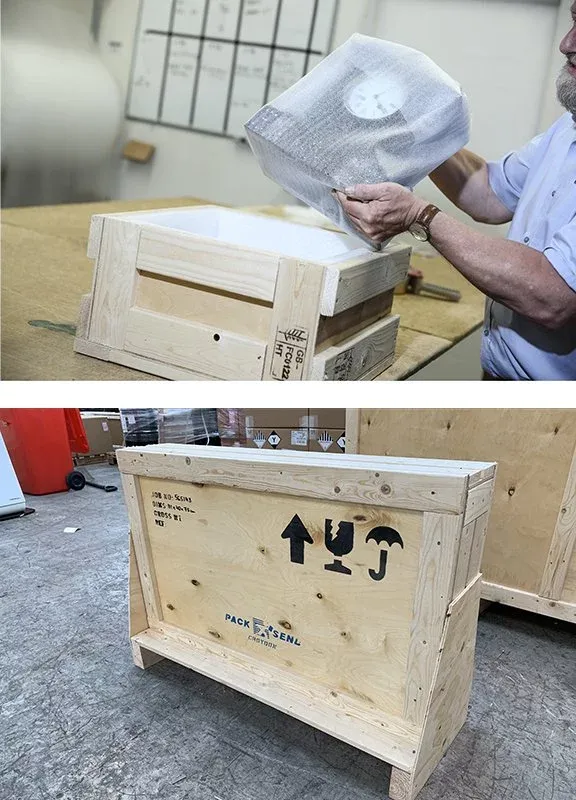
Photo: art handler packing painting into wooden crate fine art shipping, via www.packsend.co.uk
The painting was finished on a Tuesday in a second-floor studio off Mateo Street, in the industrial stretch of Los Angeles where the air smells faintly of solvent and roasted coffee. It was dry, signed, photographed, and sold. By every measure the artist's work was done. In truth, the riskiest phase of the canvas's life had not yet begun.
What happens between a studio wall in California and a parlor floor in Manhattan is one of the art market's most carefully managed and least discussed rituals. Collectors see the before and the after. Almost no one sees the between.
The First Hour: Where Most Damage Is Decided
Conservators will tell you, with surprising unanimity, that the majority of transit injuries occur not on the highway but in the first hour of packing. A painting lifted carelessly from its easel, set on its edge against an unpadded table, or wrapped while the varnish is still off-gassing, may carry a wound that only reveals itself years later as a hairline craquelure or a lifted cleavage of paint.
"The crate gets all the attention," says one fine-art handler who has shipped work for major auction houses and asked not to be named, citing client confidentiality. "But the crate is just the last line of defense. The decisions that matter are made by the person's hands in the first five minutes."
Our Los Angeles canvas was faced with glassine, cushioned in Ethafoam, and set into a double-walled travel frame before being lowered into a custom crate built to museum specifications — softwood battens, rigid corners, and a cleated lid screwed rather than nailed shut. Total build time: four hours. Total cost: more than the frame on the painting itself.
Crossing the Country Without Ever Seeing It
Once sealed, the crate left Los Angeles aboard a dedicated climate-controlled truck — not a courier van, not a padded envelope of the moving world, but a vehicle whose interior temperature and humidity are logged continuously. The target range is deceptively narrow: relative humidity between roughly 45 and 55 percent, temperatures that never swing far enough to make paint layers and canvas expand at different rates.
Vibration is the quiet antagonist of the trip. Thousands of miles of interstate hum travel up through the truck's suspension and into the crate, and through the crate into the painting's structure. Specialist drivers take routes and speeds with this in mind. Some trucks carry shock data loggers, the art-world equivalent of an aircraft's black box, so that a bump on I-40 outside Albuquerque can be documented, contested, or forgiven.
There are customs forms to consider for international legs, though on this domestic run the paperwork was simpler: condition reports with photographs at origin, a signed chain-of-custody sheet at each transfer, and an insurance certificate naming every party who would briefly hold responsibility. Each signature is, in effect, a moment where the painting changes guardians — and where liability quietly changes hands.
What the Insurance Signature Actually Means
Collectors often assume insurance is a single umbrella that follows the work door to door. The reality is more like a relay. The artist's policy covers the work until it leaves the studio. The carrier's fine-art policy covers it in transit. The destination may require a separate rider once the painting crosses the brownstone threshold. Gaps between those policies are rare but not impossible, and the moment of handoff — driver to building staff, handler to homeowner — is where coverage disputes tend to begin.
"I always tell collectors: be the last signature in the chain yourself," says a New York–based art advisor. "Don't let the painting be signed for by a doorman. Stand there, open the crate, and look at the work before anyone leaves."
Arrival: The Wall Is Not the Finish Line
When the crate reached the Manhattan brownstone, it did not go straight to the wall. It was left, closed, in the room where the painting would hang, for twenty-four hours. This acclimatization period — standard practice among registrars — lets the canvas and the paint film adjust gradually to the new environment rather than shock against it. A painting that travels from arid Los Angeles to humid New York in July is, in a sense, a small refugee from another climate.
The unwrapping, the hanging, the first look: those belong to the collector. The journey belongs to an invisible workforce of crate builders, drivers, registrars, and conservators whose entire profession is organized around a single outcome — that the painting arrives exactly as it left.
It did. The collector hung it that evening. Somewhere in a crate-builder's workshop in Vernon, California, the leftover foam was swept up, and another painting was already being measured.
For every work that hangs serenely on a wall, there is a story of screws, humidity logs, and signature lines that no one will ever frame. The art market celebrates the sale and the unveiling. Perhaps it should spare a sentence for the road in between — the miles a painting endures so that, on arrival, it can pretend none of it happened.