Reading the Chemistry: How a Painting's Pigments Betray Its Birth Decade
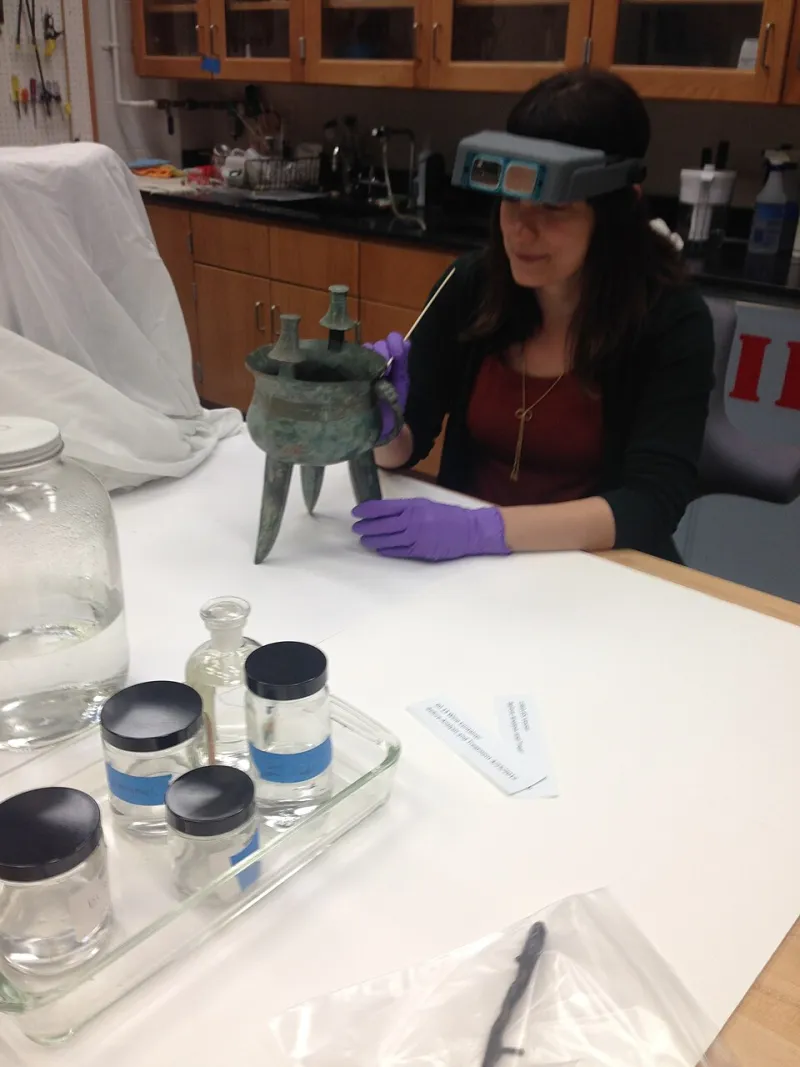
Photo: RichardMcCoy, CC BY-SA 3.0, via Wikimedia Commons
Every painting carries a clock inside it. Not the metaphorical clock of style or subject matter, but a literal chemical timestamp embedded in the materials themselves. For collectors navigating the American contemporary market, understanding how pigments enter and exit the supply chain has become one of the most quietly powerful tools in due diligence — and one of the least discussed.
The Fingerprint Hiding in Plain Sight
Ask a conservator how they begin assessing an unfamiliar work and the answer rarely involves the signature. It involves the paint. Pigments, like all manufactured materials, have biographies. A cadmium red produced in 1965 differs measurably from one produced in 1995, not because the chemistry changed dramatically, but because the industrial processes, regulatory constraints, and supplier networks around it did.
This is what specialists call pigment archaeology: reading a canvas's decade through its chemistry. Under magnification and, when necessary, under instruments like Raman spectroscopy or X-ray fluorescence, a painting becomes a stratigraphic record of what was commercially available at the moment of its making.
When Chemistry Rewrites the Story
The stakes become vivid in disputed attributions. There are documented cases in the American market where a work claimed to date from the 1940s was found to contain titanium white in a formulation that did not reach widespread commercial use until two decades later. No amount of stylistic argument survived that finding. The paint had spoken.
The reverse also holds. A genuine work can be dismissed as a fake because a collector assumed a pigment was anachronistic, when in fact the material entered circulation earlier than folklore suggested. Pigment dating rewards those who consult the literature rather than their instincts.
A Short History Written in Scarcity
Consider a few landmarks every American collector should carry in mind:
- Cadmium pigments, first commercialized in the mid-nineteenth century, became reliably consistent only after industrial refinement in the early twentieth. A heavy-handed, slightly gritty cadmium orange often signals an earlier decade; a buttery, high-tinting-strength version suggests postwar manufacture.
- Cobalt violet and cobalt yellow, prized for their luminous transparency, have cycled through periods of scarcity as cobalt ore supply chains shifted. Paintings from the 1970s, when cobalt prices spiked, sometimes substitute cheaper substitutes — a detail that dates a work as surely as a receipt.
- Titanium white, which displaced lead white across American studios in the mid-twentieth century, marks a clean generational divide. A canvas built on lead white grounds belongs to an earlier world than one primed with titanium.
- Quinacridone and phthalocyanine pigments, products of twentieth-century industrial chemistry, simply did not exist in artists' materials before the 1930s and did not saturate the American market until after World War II.
Each of these materials entered studios at a traceable moment. Their presence or absence narrows the window of a work's creation, sometimes to within a few years.
Regulation Joins the Timeline
The dating toolkit expanded in a new direction in recent decades as environmental and health regulation reshaped the palette. Cadmium, lead, and cobalt have all faced increasing scrutiny from agencies including the EPA and their European counterparts. Certain formulations have been reformulated, restricted, or withdrawn entirely from specific markets.
For contemporary works, this creates an unexpected forensic resource. A pigment that was discontinued in 2010 cannot appear in a work made in 2015 — unless something questionable is going on. Collectors of recent American painting are only beginning to appreciate how much regulatory history is embedded in their acquisitions.
What This Means at the Fair and the Auction
None of this replaces provenance, signature analysis, or scholarly connoisseurship. But it adds a layer of verification that is remarkably hard to falsify. Forging a signature is a matter of skill. Forging the industrial history of a pigment supply chain is a matter of chemistry.
Practical guidance for collectors is straightforward. Ask galleries and auction houses what scientific analysis accompanies a work's condition report. Reputable dealers in the American market increasingly expect the question. When a significant purchase is under consideration, an independent conservation examination — typically a few hundred dollars — is cheap insurance against a six-figure error.
The Deeper Reading
There is a quieter pleasure here beyond authentication. Pigment history is a history of American industry: of mining towns and chemical plants, of wartime supply disruptions and environmental awakenings. Every painting in a collection is also a small industrial artifact, a record of what the economy of its moment could put on a shelf.
The next time a canvas stops you in a gallery, consider looking past the image to the material. The color on the surface is an aesthetic choice. The color underneath the surface is a date.