Standing in the Room: Why the Artist's Voice Still Closes the Sale
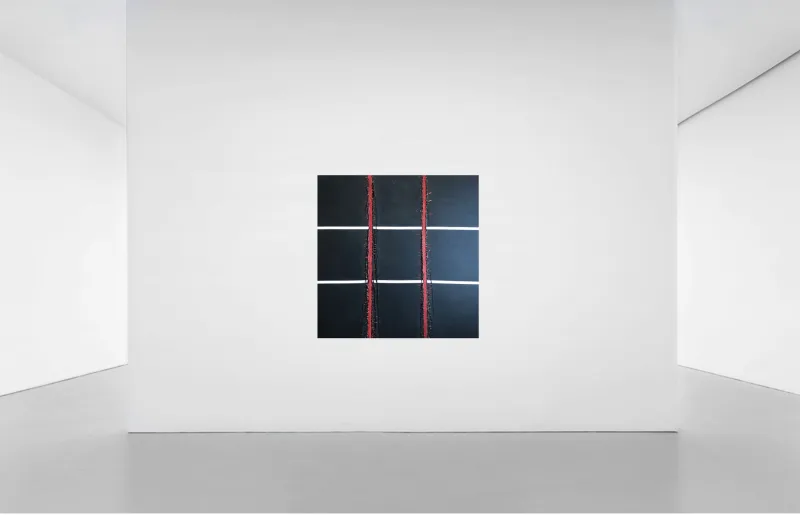
The painting had already been saved to her favorites list for three weeks when Marisa Delgado finally drove to the artist's studio in Marfa. She had studied the high-resolution images, checked the dimensions twice, even used an augmented-reality app to preview the work above her living room sofa in Austin. By every measurable standard, she was ready to buy.
And yet she waited. She waited because, as she puts it, "the painting hadn't told me anything yet." It was only after forty minutes in the studio — watching the artist turn the canvas toward the light, hearing the story of the photograph taped to the wall that started the whole series — that she committed. "The image got me interested," she says. "The conversation got me to sign."
Delgado's experience is increasingly the norm rather than the exception in American collecting, and it reveals something counterintuitive about a market that has never been more digital.
The Tap That Doesn't Satisfy
There is no disputing the convenience revolution. Online viewing rooms, marketplace platforms, and Instagram DMs have collapsed distances that once required a flight to New York or Los Angeles. A collector in Denver can acquire a work from a gallery in Marfa, Maine, or Miami without leaving the house.
But the data behind the convenience tells a more complicated story. Dealers across the country report that while first contact increasingly happens on a screen, the works that command the strongest prices — and, just as tellingly, the deepest loyalty — almost always pass through some form of direct encounter. A studio visit. A gallery walkthrough. An artist talk in a warehouse space with folding chairs and lukewarm wine.
"The screen sells the object," one Chicago gallerist observes. "The room sells the relationship. And in the end, we're not really in the object business."
What the Voice Adds That the Image Cannot
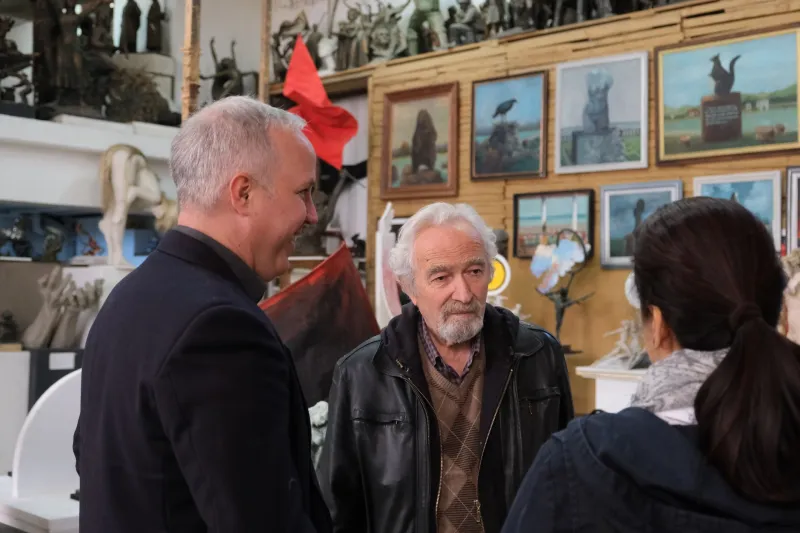
Ask artists about studio visits and most describe them with a mixture of dread and gratitude. The visit strips away the mediation of the photograph — the lighting, the cropping, the careful staging — and replaces it with something riskier: the artist's own account of what the work means, delivered in real time, with all the hesitations and revisions that honesty requires.
A painter in Santa Fe describes the dynamic plainly. "When someone stands in front of the actual canvas, they see every decision I couldn't hide. But they also hear why I made those decisions. And once they've heard that, the painting stops being a decoration and starts being a position."
That shift — from decoration to position — is precisely what the spoken story accomplishes. Wall text can supply dates and materials. A website can supply provenance. Only the artist's voice can supply intention, and intention is what transforms a purchase into a conviction.
Collectors report the same phenomenon from the other side. A first-time buyer in Portland describes attending an artist talk where the painter spent fifteen minutes on a single failed painting that led to the successful one hanging beside her. "I came to look at one canvas," she says. "I left understanding an entire career. I bought the smaller piece, honestly, because I felt like I was buying into the story, not just the wall."
The Studio Visit as Due Diligence
For established collectors, the direct encounter has also become a form of research that no database can match. Seeing an artist's studio — its discipline or disorder, the density of unfinished work, the seriousness of the practice — functions as a kind of vetting that auction records and CV lines only approximate.
Advisors describe clients who schedule studio visits the way investors schedule management meetings. The questions are practical: Is there a coherent body of work? Does the artist speak about the practice with clarity? Is there a trajectory, or a single repeatable image? The answers, gathered in person, inform decisions worth tens of thousands of dollars.
This is not snobbery, advisors insist. It is risk assessment. And the studio remains the only place where the full picture is visible.
Presence as the Ultimate Luxury
There is a broader cultural current underneath all of this. As more of American life migrates to screens, scarcity has migrated too — away from objects, which can be shipped and photographed endlessly, and toward experiences, which cannot. A dinner with the artist. A walkthrough limited to twelve people. A morning in the studio with coffee and questions.
Galleries have noticed. Walkthroughs are smaller and more deliberate. Artist talks sell out faster than exhibitions open. Some dealers now structure their entire calendar around a handful of in-person moments, treating the digital platforms as the funnel and the room as the destination.
The irony is elegant: technology made the art world more accessible than ever, and accessibility made the artist's presence more valuable than ever. The tap on the phone gets you to the door. What happens in the room — the voice over the painting, unhurried and unscripted — is what has always closed the sale.
For collectors like Delgado, the lesson landed simply. "I could have bought it from my couch," she says. "But I would have bought a picture of a painting. This way, I bought the painting."
In a market flooded with images, that distinction — the picture versus the painting, the listing versus the story — may be the only one that still matters. Presence, it turns out, is the one work of art that cannot be screenshotted.