The Sixty-Second Look: What Happens to Your Brain in Front of a Painting You'll Never Own

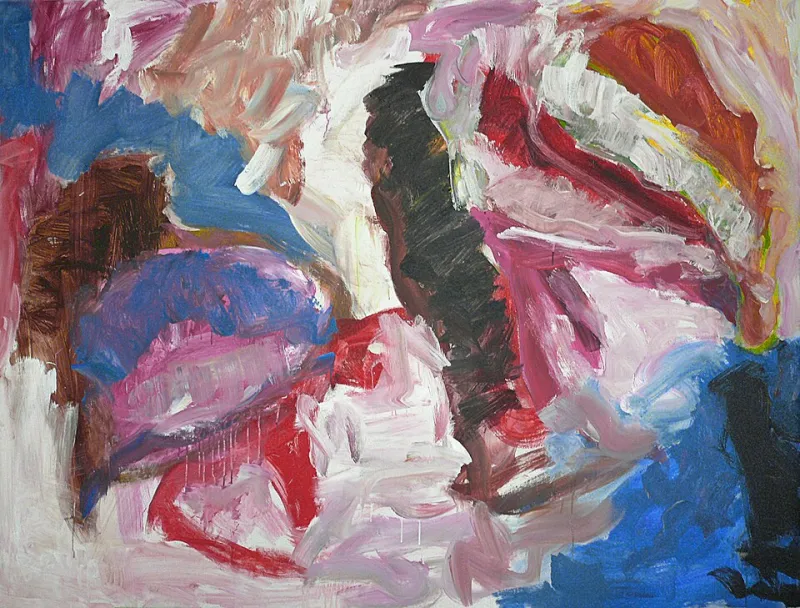
Photo: David Marcu davidmarcu, CC0, via Wikimedia Commons
The average visitor to an American museum spends somewhere between fifteen and thirty seconds in front of any given painting. That figure, repeated in museum studies circles for decades, tends to alarm people who care about art. But the number itself is less interesting than what happens inside it. In the span of a single breath, the human brain runs an entire evaluation — recognizing, feeling, judging, remembering — long before the wallet or the wall label ever enters the picture.
At N The Art Space, we spend a great deal of time thinking about how contemporary work lands: how a canvas travels from studio to wall to eye. What follows is an attempt to slow down that final step, the one nobody bills for and everybody assumes they understand.
The Gaze, Measured
Eye-tracking research out of several US university labs has quietly reshaped how curators think about looking. When visitors stand before a figurative work, their gaze follows predictable routes — faces first, then hands, then the edges of the frame. With abstraction, the pattern loosens. Viewers sweep the surface in wider arcs, lingering where contrast is sharpest, returning to whatever the painting uses as an anchor: a saturated red, a hard diagonal, an area of unexplained emptiness.
What the studies suggest is that there is no passive way to look. The brain treats a painting as a problem to be solved, and it begins solving immediately. Within roughly four hundred milliseconds, the visual cortex has parsed the composition into figure and ground. Within a second or two, the limbic system — the seat of emotional response — has already rendered a verdict. The famous 'I don't know much about art, but I know what I like' moment is not a failure of expertise. It is a genuine neurological event, happening faster than thought.
Why Some Paintings Stop You Mid-Step
Gallerists call it the hallway test. A visitor moving through a booth or a corridor of work will pass most paintings without breaking stride; a few will arrest them like a hand on the shoulder. Dealers in New York, Los Angeles, and Chicago describe this as the single most reliable indicator of a work's long-term pull — more reliable, often, than credentials or price.
Artists are not blind to this. Some resist it, refusing to design for the glance, insisting that their work rewards the patient viewer rather than the passing one. Others openly engineer for it. A painter working large in a Marfa-adjacent studio described it to us plainly: 'The first three seconds are the only thing I control. After that, it's between them and the painting.' The tools of those three seconds are old ones — scale, chroma, imbalance — deployed with a contemporary understanding of just how crowded the visual environment has become. A painting today competes not only with other paintings but with the entire attention economy.
The Collector's First Acquisition
Here is where the market conversation usually begins, and where we'd argue it usually begins too late. Before a work is acquired, it is attended to. Attention is the first transaction, and unlike money, it is spent involuntarily. You cannot decide to be stopped by a painting; you can only put yourself in the room where it might happen.
This has practical consequences for anyone building a collection. The collectors we speak with who are most satisfied with their acquisitions rarely describe falling in love at an auction preview or a fair's VIP hour. They describe the accidental encounter — the work seen while walking somewhere else, the painting that made them cross a room. The sixty-second look, in other words, is not a degraded form of engagement. For most people, it is the whole of it, and the purchase, when it comes, is simply a way of protecting that look from ever being lost.
Designing for the Glance
There is a quiet irony in contemporary exhibition design. Institutions invest enormously in wall text, audio guides, and interpretation, yet the research suggests those aids arrive after the decisive moment has passed. The paintings that stay with visitors — the ones named in exit interviews months later — are rarely the ones with the richest labels. They are the ones that did something to the eye before language got involved.
Artists who understand this are not cynical; they are realistic about the conditions under which their work will be seen. American galleries, from the white cubes of Chelsea to repurposed warehouses in Detroit and Marfa, all impose the same basic reality: people are moving, and you have their attention for less time than you think. Work that accepts this condition — that treats the glance as a legitimate portal rather than a vulgar shortcut — tends to travel further.
What the Second Minute Holds
None of this is an argument for speed. It is an argument for honesty about where looking actually starts. The sixty-second look is the door; everything a painting offers — its humor, its grief, its slow-burning formal intelligence — waits on the other side. But doors matter. A collector who knows what happens in their own first minute is better equipped to trust it, and an artist who understands the glance without pandering to it is better equipped to survive it.
The painting you will never own can still own a minute of you. In the arithmetic of a life spent around art, that may be the most durable transaction of all.