What the Walls Hear: Inside the Acoustic Lives of America's Studio Painters
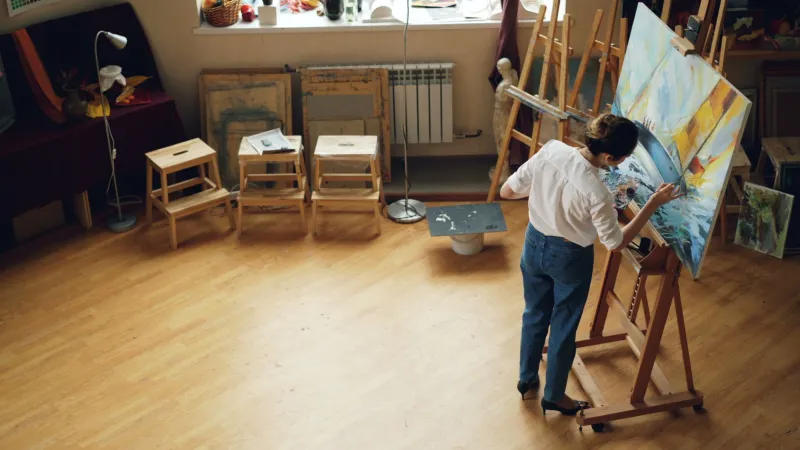
Ask a painter about their practice and the conversation usually turns to color, scale, or surface. Rarely does it turn to sound. Yet in studios across the country — a converted barn in upstate New York, a warehouse bay in Marfa's orbit, a spare bedroom in Portland — the question of what fills the air while paint dries has become an unexpectedly serious one.
For a handful of contemporary painters, the sonic environment is not background. It is infrastructure.
The Room That Refuses to Speak
Consider the case of a Brooklyn-based abstract painter who asked that her studio remain unnamed in this piece, fearing that the mythology of silence might overtake the work itself. Her rule is absolute: no music, no podcasts, no phone. The only sounds are the radiator, the freight trains crossing the Pulaski Bridge, and the faint tack of tape lifting from canvas.
"When the room is quiet, I can hear whether a brushstroke was confident," she told us. "That sounds precious, but it isn't. It's diagnostic. Hesitation has an acoustics to it."
Her position is more common than one might assume. A loose but recognizable cohort of younger American painters — many trained in the anything-goes atmosphere of MFA programs, where studio playlists were practically curricular — has begun retreating into deliberate quiet. Some describe it as a reaction against the attention economy. Others frame it in more formal terms: silence flattens the boundary between the painter's internal rhythm and the painting's own.
Side B of the Studio
At the other pole sit the vinyl loyalists. One painter in Santa Fe keeps a modest turntable at the studio door and a strict protocol: one record per working session, chosen before the first mark. The constraint, he insists, functions like a frame within a frame.
"The record has a length, an arc, a side that ends whether you're ready or not," he explained. "That ending is useful. It tells me when to step back. If I streamed, I'd never stop. The algorithm has no opinion about when a painting is finished."
His shelves lean heavily toward solo piano and West African kora recordings — music with breath and space in it, he says, music that leaves room for the room. He is quick to distinguish this from the painter-as-DJ fantasy. The music is not a mood board. It is a clock, a metronome, a companion with its own agenda.
Between these poles lies everything else: the painter in Chicago who works to field recordings of Lake Michigan in November; the Los Angeles artist who keeps a small theremin plugged in but switched off, a kind of sonic totem; the Philadelphia painter who claims the whir of her window unit in July has shaped an entire summer body of work — looser, she says, more humid in every sense.
Does Sound Reach the Surface?
The honest answer is that no one has proven it, and most artists are suspicious of anyone who claims certainty. But the anecdotal evidence stacks up in interesting ways. Several of the painters we spoke with described tempo effects — faster music producing faster, less revised marks; silence producing longer looking and, eventually, longer decisions.
A painter and former percussionist now based in Hudson, New York, put it in musical terms. "Rhythm doesn't just live in your ears. It lives in your wrist. If I've spent the morning listening to Coltrane, there's a physicality in that afternoon's brushwork that I can't fake. I'm not painting the music. The music has already gotten into the arm."
Art historians will recognize a long lineage here. Philip Guston famously painted to music, and the Abstract Expressionists' flirtation with jazz is well documented. What feels distinct now is the deliberateness — the sense that the sonic environment is being designed rather than merely inhabited.
When Galleries Learn to Listen
The trend has not stayed inside the studio. A small but noticeable number of American galleries and project spaces have begun curating soundscapes alongside painting exhibitions — a low ambient track in the front room, a playlist keyed to the palette, or in one notable case at a Los Angeles space last year, a commissioned composition played at conversation volume, low enough that most visitors assumed it was the building.
The results are debated. Some visitors experience the pairing as an enrichment, a way of slowing the walk and tuning the eye. Others find it presumptuous — an instruction manual for feeling, attached to work that resists instruction. Dealers, characteristically, are pragmatic: a soundscape keeps visitors in the room longer, and time in the room is the quietest form of persuasion the art world has.
What seems clear is that the question has become legitimate. The hushed, white-walled neutrality of the conventional gallery was always a fiction; buildings hum, HVAC systems sigh, floors creak. Acknowledging the ear does not diminish the eye. If anything, it admits the whole body into the encounter.
A Practice That Extends Past the Edge
Toward the end of one conversation, a painter in her fifties, three decades into a career of large color-field canvases, offered a framing that has stayed with us.
"People think a studio is a place where you make things," she said. "But it's a place where you listen for a long time, and then make something. The painting is just the part that gets to hang on a wall."
Whether the marks on a canvas carry the trace of a record's final chord, or of a freight train's passing, or of nothing at all, may never be measurable. What is measurable is the growing seriousness with which American painters are asking the question — and the quiet insistence, in studios from coast to coast, that the room itself is a collaborator.
The silence, it turns out, was never empty.