Before the Art, the Ascent: A Tour of America's Most Persuasive Museum Stairways
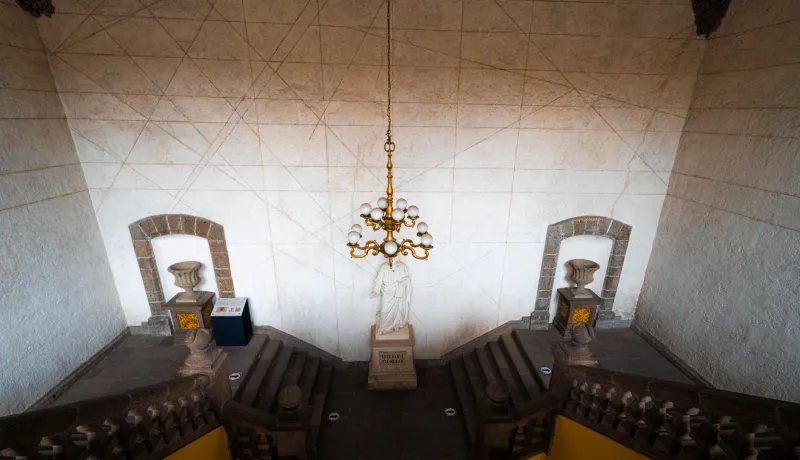
Every museum visit begins with a transition, and in American museums that transition is often vertical. We climb, we ascend, we spiral upward — and in doing so, we are being prepared. The stairwell is the museum's opening argument, delivered before any label text or introductory wall panel gets the chance.
Consider the path as a designed experience in its own right. What follows is an informal tour of ten American stairways, ramps, and rotundas that shape our expectations of art as powerfully as any exhibition design.
The Ceremonial Ascents
The grand staircase of the Metropolitan Museum of Art in New York remains the country's definitive statement of arrival. Its broad, shallow steps slow the body, and the body slowed is the body made receptive. You cannot hurry up those stairs; the architecture forbids it.
At the Art Institute of Chicago, the lions guard a stairway that performs a similar ritual, though with a Midwestern directness — stone, symmetry, and the steady message that what waits above has earned your effort.
The Museum of Fine Arts, Boston, offers the neoclassical version of the same idea: a forecourt and stair sequence that treats entry as occasion.
The Modernist Interventions
Frank Lloyd Wright's Guggenheim rotunda inverted the whole grammar of museum circulation. Here the visitor takes an elevator to the top and descends along a continuous ramp, art unfolding in a gentle slope rather than discrete rooms. The building does not contain the experience; it is the experience, and generations of visitors have found the works on the ramp hard to separate from the ramp itself.
The Whitney Museum's Renzo Piano building places its outdoor stairways and terraces as deliberately as its galleries, letting the city interrupt the art at intervals — a distinctly contemporary argument about where art ends.
At the de Young Museum in San Francisco, Herzog & de Meuron's twisting copper tower culminates in a viewing floor reached by elevator, but the approach through the sculpture court stages the ascent as gradual revelation.
The Quiet Persuaders
Not every persuasive stairway is grand. The brutalist concrete of the Everson Museum in Syracuse forces the visitor through a compressed, shadowed entry before opening into light — a darkness-to-clarity sequence that primes the eye for form.
The Hirshhorn's cylindrical form in Washington, D.C., offers a sculptural fountain courtyard as its threshold, an outdoor room that decompresses visitors before the inward turn.
The Broad in Los Angeles climbs through the "veil-and-vault" geometry on an escalator that pierces the ceiling — a deliberately theatrical ascent into daylight, choreographed down to the moment the gallery opens above you.
And in Houston, the Menil Collection's low-slung entry keeps the visitor at ground level, a refusal of the ascent altogether. The message: art here is not above you. It is beside you.
Why the Path Matters
Architecture historians have long noted that circulation is ideology. A Beaux-Arts staircase asserts hierarchy and reverence; a Wright ramp asserts flow and continuity; a Menil ground floor asserts intimacy and equality. These are arguments about what art is, made in stone, steel, and concrete.
For contemporary artists, the inherited path is both constraint and collaborator. A painting installed at the top of a grand stair arrives pre-loaded with ceremony. The same painting in a corridor arrives as an encounter — casual, surprising, democratic.
The next time you visit an American museum, resist the urge to hurry past the threshold. Linger on the stairs. The building has been talking to you since the sidewalk, and it has opinions about what you're about to see.