Chasing the Sun: Inside the Light Pilgrimages Reshaping American Landscape Painting
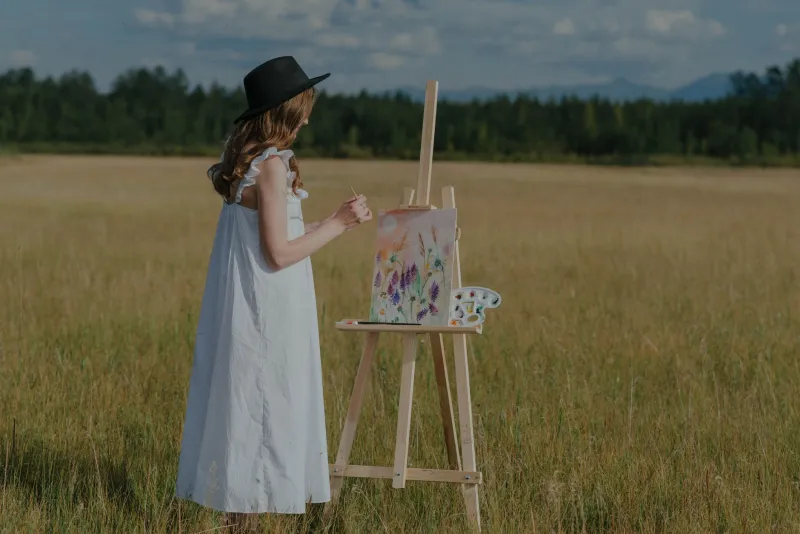
At 5:40 on a February morning, the painter Marisol Vega stands in the high desert outside Taos with a thermos of coffee and a small panel already gessoed the night before. She is waiting for a light she cannot find in her Brooklyn studio — the long, amber raking glow that only the Southwest's low winter sun produces. For the next six weeks, this is her entire schedule: rise before dawn, paint until the shadows turn blue, and record what the day gives her.
Vega is part of a quiet migration. Across the country, contemporary painters influenced by plein-air tradition are organizing their practices not around gallery deadlines or residencies, but around the behavior of light itself — treating geography as a raw material as essential as oil paint.
The Geography of a Palette
Ask any of these artists why they travel and the answer is rarely about subject matter. It is about temperature. Coastal Maine in June delivers mornings filtered through sea fog, softening edges and muting color until everything reads as a study in gray-greens. The high desert of New Mexico does the opposite: its altitude strips the atmosphere thin, so shadows deepen to violet and adobe walls burn orange at dusk.
"You can't fake that at home," Vega says. "You can look at photographs all day. But the way light moves across a wall in real time — that's information. That's what the painting is actually about."
The result is that certain regions have become synonymous with certain chromatic signatures. Collectors who follow contemporary landscape painting can often identify a work's origin before reading the label: the cool, damp luminosity of the Pacific Northwest, the hard-edged brilliance of West Texas, the humid haze of the Lowcountry.
Three Pilgrimages, Three Bodies of Work
Vega's Taos residency is one example. Painter Daniel Okafor's is another: for three consecutive autumns, he has driven the length of Route 1 in California, stopping at state parks to capture the particular gold of late-afternoon light through eucalyptus. The resulting series — thirty-two canvases — sold out before its Los Angeles debut.
And on Monhegan Island, twelve miles off the Maine coast, Ruth Ellison has spent a decade returning each September to the same granite headland. Her work has grown progressively more abstract over the years, but the island's fog-diffused light remains the constant. "The subject left the painting a long time ago," she says. "The light never did."
What unites these artists is a conviction that place is not decoration. It is argument. A body of work built in one light carries a coherence that studio production, however skilled, struggles to replicate.
How Light Reaches the Price Tag
There is a market dimension to all of this, and dealers are candid about it. Regional light carries regional provenance — and provenance carries value. A Monhegan painting arrives with the island's long artistic lineage attached, from Rockwell Kent to the present. A Taos canvas inherits a century of modernist mythology.
Galleries have learned to frame these narratives carefully. An artist who paints the same Vermont hillside in four seasons is offering collectors a story as much as an image, and stories hold value in ways that pure technique does not. Several of the artists interviewed for this piece noted that their travel-based series command noticeably higher prices than their studio work — sometimes by a factor of two.
Skeptics might call this branding. The artists themselves frame it differently: the pilgrimage is a discipline, a way of forcing honesty into a practice that studio comfort can erode.
Bringing the Light Home
There is, of course, an irony waiting on the collector's wall. A painting made under New Mexico's thin, brilliant sky will spend its life under whatever bulbs a Manhattan apartment happens to have. Increasingly, artists are aware of this and even factor it in — Vega now photographs her finished panels under three different light temperatures and includes notes with each sale.
"The painting leaves the desert," she says, laughing, "and I want it to survive the living room."
It is a small gesture, but a telling one. In a market crowded with competent images, the artists commanding attention are the ones who treat light not as a subject but as a collaborator — and who are willing to chase it, season after season, across state lines.