Nine Pigments and a Promise: The Palettes Contemporary Artists Refuse to Abandon
Ask an artist about color and you will rarely get a technical answer first. You will get a place, a person, a season. The palette, it turns out, is autobiography rendered in pigment — and in studios across the country, certain colors keep returning like familiar handwriting.
We spent time with six working artists to understand why. Their answers reveal less about chemistry than about devotion.
The Discipline of Nine
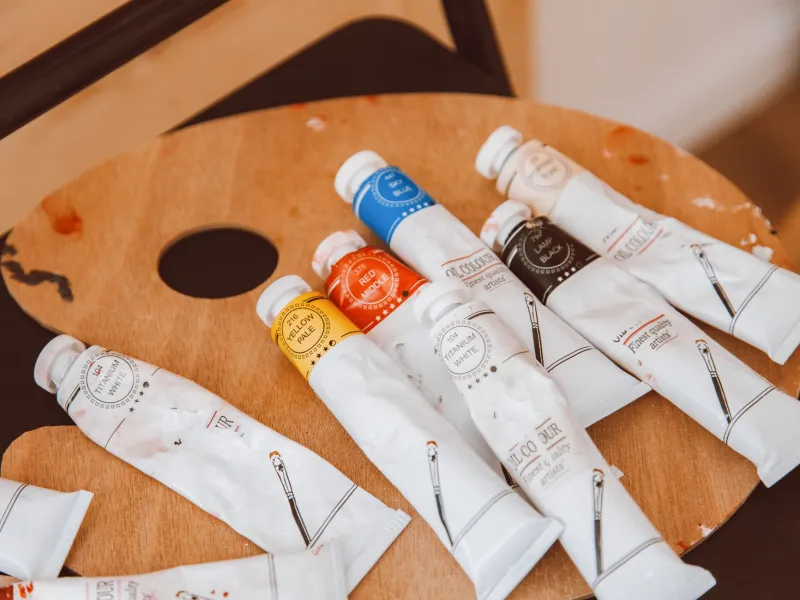
Marta Reyes's studio in Marfa-adjacent West Texas contains exactly nine tubes of paint. Not ten. The constraint began as an economy measure during graduate school and hardened into a philosophy. "Every additional pigment is a decision I don't have to make honestly," she says. Her palette — two yellows, two reds, two blues, a green, a burnt sienna, titanium white — produces chromatic ranges most painters would swear required twenty colors. The discipline shows in the work: canvases that feel simultaneously restrained and luminous, desert light translated through subtraction.
Collectors often mistake limitation for austerity. Reyes disagrees. "Nine pigments is abundance," she insists. "It's abundance of attention."
Glazes from the Scrapyard
Ceramicist Devon Oka's palette comes from somewhere unlikelier than any tube: industrial waste. Working from a kiln yard outside Cleveland, Oka sources slag, machine filings, and foundry dust from regional manufacturers, then tests each batch obsessively until a glaze emerges. The results are colors with no commercial equivalent — a bruised teal that comes from rusted iron oxide, a slate gray drawn from steel byproduct.
"These are Ohio's colors," Oka says. "They come out of the ground and the furnaces here. I couldn't order them from a catalog." Each vessel is, in a sense, a portrait of local industry — fired evidence of what the region makes and discards.
The Blue of a Particular Afternoon
For painter Junie Aldridge, the palette is memory with a date attached. Her signature cobalt — mixed with a whisper of violet — reproduces the sky over her grandmother's porch in Savannah on a specific August evening she has never stopped painting. Thirty years of work, and the blue keeps evolving, never quite arriving.
"I know it's sentimental," she laughs. "But sentiment is material. It mixes as well as any medium."
Neutrals, Defended
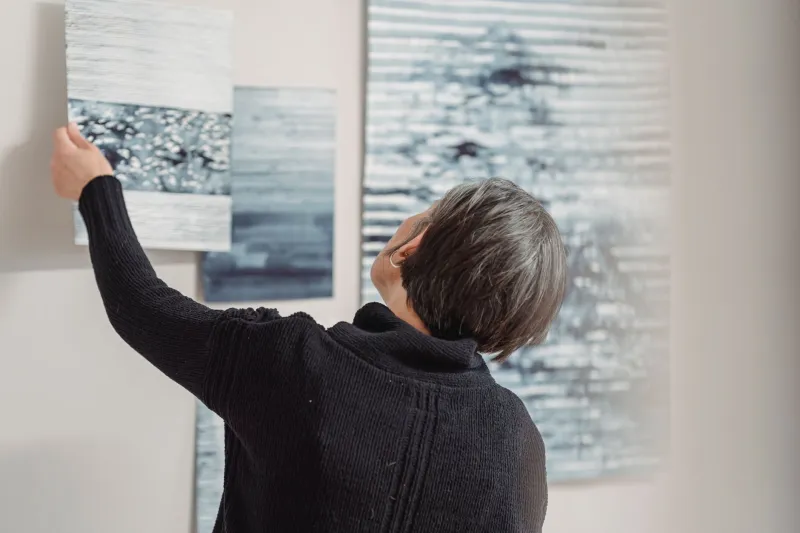
Not every obsession is chromatic. Portland-based painter Elias Wren works almost entirely in grays — eleven of them, each mixed from complementary primaries rather than purchased. "Gray is the color of thinking," he argues. His large-scale canvases, which read as fog studies or erased landscapes, reward long looking: buried within each neutral is a full-color argument.
What Collectors Should See
For those acquiring contemporary work, an artist's palette is more than a stylistic signature — it is a coherent worldview under pressure. A restricted palette signals discipline; a scavenged one signals place; a remembered one signals fidelity. When evaluating a work, ask what the color is doing that convenience would not allow.
The Palette as Promise
The painters and makers profiled here share one conviction: color is not decoration but commitment. Reyes will likely die with nine pigments. Oka will keep driving to the foundry. Aldridge will keep chasing one Savannah evening. In an art world that rewards reinvention, there is something quietly radical about a palette you cannot quit — a promise made in pigment and kept for a career.