Off the Clock, On the Record: Five American Painters and the Hours That Belong to Them
There is a persistent mythology around the American painter: the person who never stops working, who eats standing up, who measures a good week in finished canvases. It is a flattering story for the work ethic and a poor one for the human being. Spend any real time around working artists and you will find something less monastic and more ordinary — and far more interesting.
For this feature, we followed five contemporary painters through a single day each, deliberately chosen on days when no painting was planned. What emerged was not a portrait of idleness but of a different kind of attention. Call it drift with a purpose. Call it the uncredited material in contemporary practice.
The Court Before the Canvas
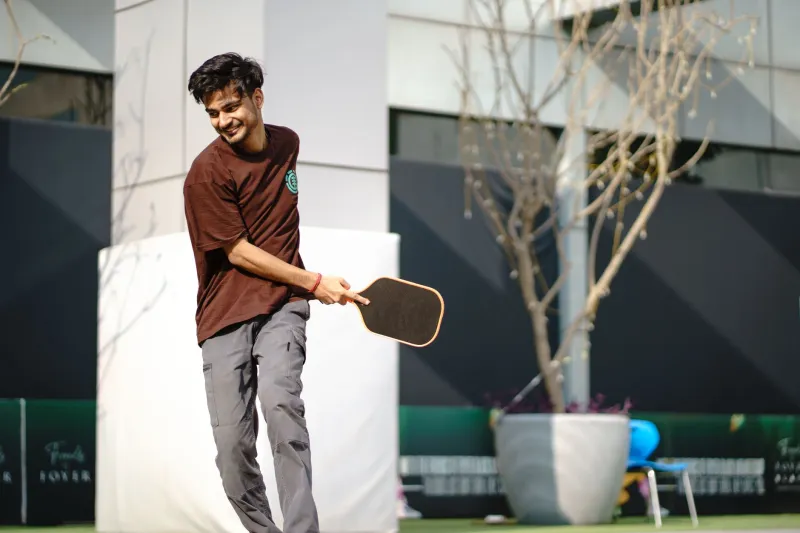
In a suburban gymnasium outside Columbus, Ohio, painter Dana Whitfield plays in a Tuesday-morning pickleball league with a rotating cast of retirees and schoolteachers. She is quick to say the game has nothing to do with art, and then, unprompted, keeps talking about it.
"Rally pressure is studio pressure," she says between games. "You miss, you reset, the ball comes back. Nobody cares that you missed. The rhythm of it — that's the same muscle I use when a painting stalls."
Whitfield's recent series of small, densely layered abstractions sold out at her gallery's fall presentation. She credits the singles court, half-jokingly, with teaching her when to stop forcing a shot. Collectors who meet her at openings are often surprised to learn that her compositional patience was rehearsed in sneakers, not smock.
Four Hundred Miles of Nothing Much
Marcus Ellery, a landscape painter based in Santa Fe, takes what he calls "dry trips" — road journeys with no destination, no sketchbook, and a standing rule against photographing anything. Last spring he drove Route 50 through Nevada, the so-called Loneliest Road in America, and saw, by his own count, almost nothing worth painting.
"That's the point," he says. "The eye needs fallow ground. If every drive is a scouting mission, the landscape becomes inventory. On a dry trip, it gets to just be terrain again."
Two months after returning, Ellery began the large-scale high-desert canvases that now anchor his current exhibition. He resists any tidy cause-and-effect. But he notes that the paintings came faster and looser than anything he'd made in years — and that he no longer apologizes for the miles in between.
The Ritual of the Pot
In a walk-up apartment in Chicago's Pilsen neighborhood, Sofia Reyes paints only after cooking a full meal, a habit she picked up from her grandmother in Guanajuato. The cooking is elaborate even when she eats alone: fresh tortillas, a long-simmered salsa, something braised on a Sunday.
"Kneading masa is the closest thing I do to mixing paint," Reyes says. "You learn texture with your hands. You learn when something is done by feel, not by timer."
Her still-life paintings — kitchen tables crowded with chiles, ceramic pitchers, cut limes — have drawn a growing following among Midwestern collectors. Critics read them as statements about labor and inheritance. Reyes reads them as portraits of a kitchen she happens to know by heart. The meals are not research. They are the source.
Thrift as a Second Education
Portland painter James Okafor spends most Saturday mornings in thrift stores and estate sales, hunting for old frames, vintage textiles, and — his particular obsession — mid-century record sleeves. He rarely buys anything expensive, and almost nothing he buys ends up in a painting directly.
"It's an education in other people's taste," he explains, flipping through a bin of worn paperbacks. "Somebody chose this color combination in 1963 and it worked. Somebody else's failure teaches you even more."
Okafor's collage-based canvases carry the residue of those Saturdays in their palettes and their odd, specific nostalgia. He calls the thrift run his "second studio," and treats it with the same seriousness: same day, same route, same coffee beforehand.
Why Collectors Should Care
There is a practical argument here, not just a romantic one. Collectors evaluating an artist's career tend to look at output, exhibitions, and market history. What they are rarely shown is the ecology that sustains the output — the leagues, the drives, the kitchens, the secondhand aisles.
A painting made by someone with a full life carries a different kind of confidence. It suggests an artist who is not squeezing the work dry, who has somewhere to put the pressure when the studio gets loud. Several of the artists we spoke with noted that their best collectors eventually learn about their lives off the clock, and that the knowledge deepens rather than dilutes the work's appeal.
The Unlisted Material
No supply catalog sells leisure. No exhibition label credits a pickleball league or a pot of salsa as a medium. But drift — real, unproductive, restorative drift — may be the least documented material in contemporary American painting.
The five painters featured here would resist being reduced to their hobbies, and they should. The point is not that artists are interesting when they're not working. The point is that the work is better because they are. The hours that belong to them, spent on courts and highways and in kitchens and thrift-store aisles, are the quiet subsidy behind every canvas that eventually meets a wall.
The next time a painting stops you in a gallery, it is worth remembering: somewhere, before that image existed, the artist was doing absolutely nothing in particular. And it mattered.