The Polite Refusal: How Artists Protect Their Practice and Their Relationships
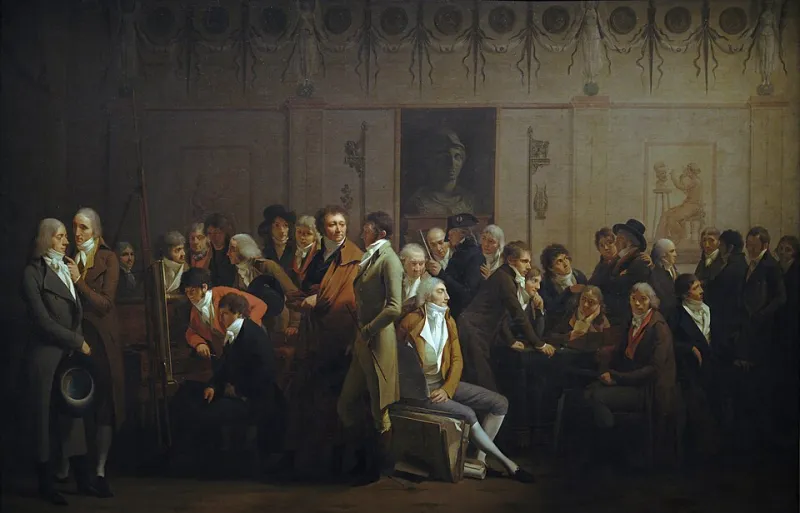
Photo: Louis-Léopold Boilly, Public domain, via Wikimedia Commons
Most artists learn early how to say yes. Yes to the group show, yes to the studio visit, yes to the commission that pays rent. The harder skill is the no—specifically, the no that protects a practice without turning a colleague, a collector, or a curator into an adversary. In a market where relationships compound slowly, the way an artist declines matters as much as the work itself.
This is not a plea for rudeness. It is an argument for clarity. A well-placed no is a form of curation. It tells the market what the practice is for, what it will not do, and where the limits sit. Artists who never say no become difficult to read; their work begins to look like a service.
The Commission That Isn’t Yours
The wrong commission usually announces itself early. It may be a palette request—“something in blues to match the sofa”—or a size demand that ignores how the artist actually works. It may be a corporate lobby that wants a large, cheerful abstraction by a painter whose practice is built on restraint. It may be a portrait commission from a collector who has never bought a figurative work and is testing the artist’s willingness to please.
Dealers describe a predictable pattern: the artists who get into trouble are not the ones who decline, but the ones who accept and then resent the job. A commission accepted under pressure becomes a negotiation conducted in bad faith. The collector feels it. The work shows it.
Read the Room Before the Studio Visit
Not every no begins with a commission. Studio visits are their own negotiation. A collector who arrives with a decorator, a binder of fabric swatches, and a fixed budget is not necessarily a red flag—but a collector who arrives without looking at the work is. Artists learn to read the difference between curiosity and shopping.
Practical boundaries help. Set a visit window. Put the works you want to discuss on the wall. Keep a price list ready, and do not apologize for it. If a visitor asks for a discount before asking about the work, the answer is probably no. If they ask what the artist is reading, the conversation can continue.
Red Flags in Plain Language
The language of a bad request is often ordinary. “Can you make it bigger and cheaper?” is a red flag. “My designer will send a palette” is another. Requests for free sketches, unlimited revisions, or a “test” piece are not collaborations; they are unpaid labor with a deadline. Net-60 payment terms on a commission are a financing request disguised as a purchase order. A demand for full copyright or unlimited reproduction rights is a deal-breaker dressed as a formality.
Artists do not need to name these flags in the moment. They need to recognize them. The best response is often a version of: “That is not how I work, but here is what I can offer.” The sentence is polite, final, and leaves the door open to a different conversation.
The Script Is Not the Point
There is no perfect script. Artists who rehearse a paragraph often sound like they are reading one. What matters is timing and specificity. Decline early, before expectations harden. Be specific about what is being declined: the size, the palette, the timeline, the budget, the rights. Avoid the vague “I’m too busy,” which invites a follow-up in three months. A clear reason—“I’m not the right artist for this”—is more respectful than a soft maybe.
Dealers say the most damaging no is silence. A collector who waits six weeks for an answer will remember the wait longer than the refusal. A two-day response, even a negative one, reads as professionalism.
Price the No
Declining work has a cost, and artists should price it. A commission that consumes a month of studio time is not free just because it was refused; it is an opportunity cost. Some artists build a “no fee” into their thinking: they quote a price high enough that the wrong client will decline, or they require a deposit that compensates for the disruption. Others refer the request to a colleague and preserve the relationship without taking the job.
Pricing is also a boundary. An artist who quotes firmly and consistently is easier to work with than one who negotiates against themselves. A deposit, a revision limit, a kill fee, and a clear timeline are not hostility. They are the terms of a professional relationship.
The Strategic No and the Burned Bridge
There is a difference between a strategic no and a burned bridge. A strategic no is early, clear, and paired with an alternative: another artist, another format, another timeline. A burned bridge is usually caused by silence, condescension, or a yes that was never meant. Artists who decline with respect are rarely punished for it. The collector who was told no clearly often returns for the next available work.
What Dealers Wish Artists Knew
Dealers, for their part, wish artists understood that a no can protect the gallery’s position too. A commission that goes wrong costs the gallery more than a declined one. A clear boundary makes the artist easier to represent, not harder. The market is small enough that reputation travels; the artist who is known for honest limits is often the one collectors trust.
The art of the no is not a retreat from the market. It is a way of staying in it on terms that allow the work to remain the work. The artists who master it tend to be the ones still painting, years later, with the same collectors—and the same voice.